
About Peptides, Part 1: What They Are and Where the Ones Online Come From
To start, here are basic but important definitions.
Proteins, Amino Acids and Peptides
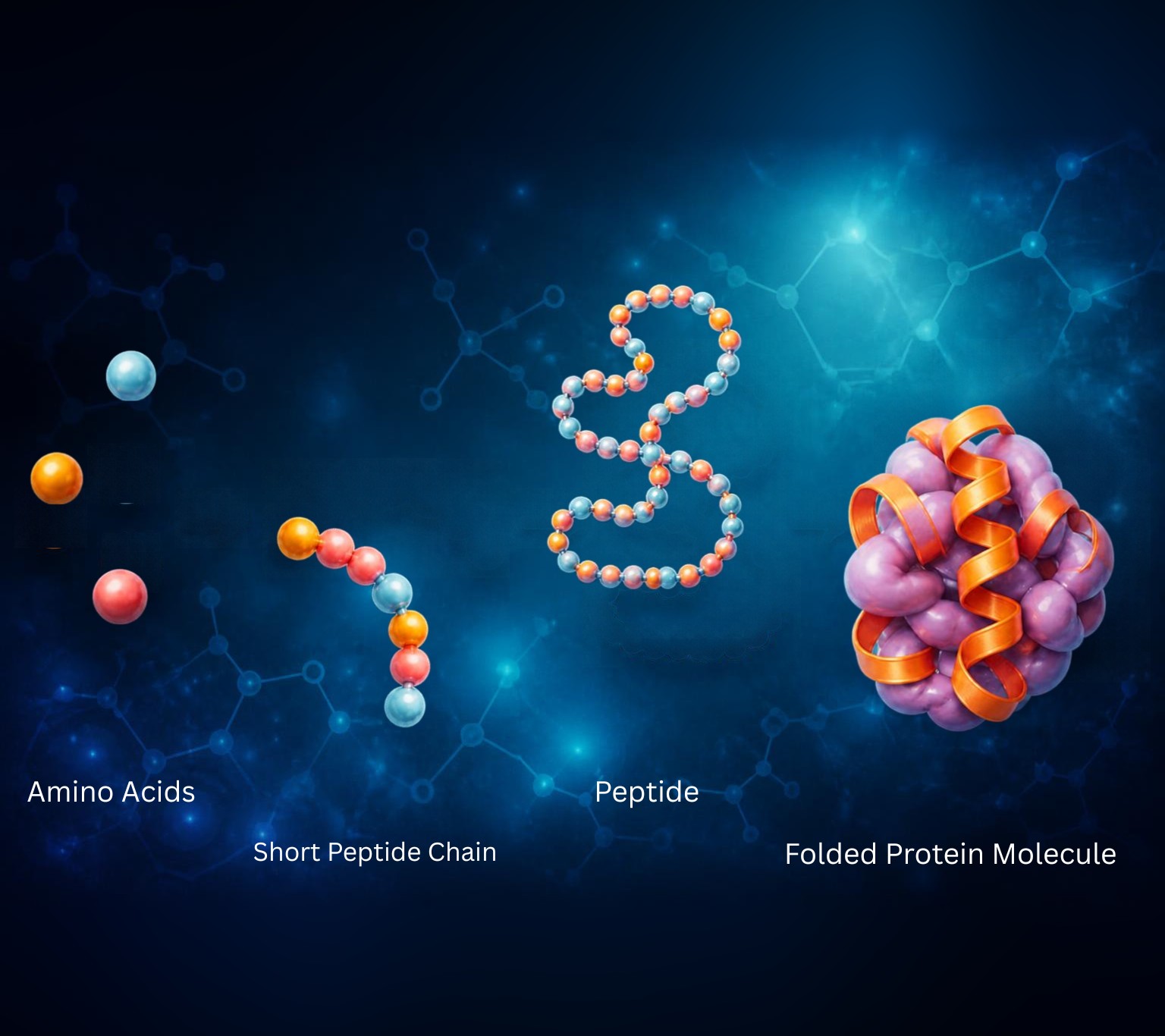
Proteins are well-known major molecules that are vital to all life. They are complex chains of amino acids (like Lego blocks) that provide building materials, communication materials, food sources, and much more in all living things.
Amino acids are tiny molecules that are building blocks (think Lego blocks) hooked together to build all proteins. Human proteins are built from only 20 different amino acids (think Lego blocks in 20 different colors). These amino acids create several thousand different protein molecules. Some your body can produce from other molecules, and about 9 essential amino acids we must get from our daily food intake.
Peptides are small amino acid chains that are important as chemical messengers and regulators. They can be as small as a 2-amino-acid chain and as large as a 50- to 100-amino-acid chain. They interact with various cells and set off important processes such as hormone release, tissue repair, brain receptor communication, and more. The most well-known are insulin, oxytocin, somatotropin (growth hormone), GLP-1 (glucagon-like peptide-1), and more.
So now you understand the basics: peptides are small proteins made of chains of molecules known as amino acids. Our body uses peptides (small proteins) and proteins, which can be thousands of amino acids long, to keep this living organism working.
It is thought that our body has over 7,000–10,000 natural peptides working throughout the body, doing various complex tasks. Some peptides, like insulin, are essential; without them, the body dies. Others exist in tiny amounts, handle rare tasks, and may never be fully evaluated or understood.
Why Peptides Taken by Mouth Usually Don’t Work
Now we need to understand protein digestion. When you have eaten a piece of meat, a bowl of beans, or a serving of green peas, the proteins in these foods go through our digestion process. The stomach starts mechanically and chemically breaking apart these amino acid chains into smaller units using digestive enzymes, and this process continues in the intestine until individual amino acids (our Lego block example) are floating around and can be absorbed through the intestinal wall into our bloodstream and sent throughout the body.
Why do you need to know this? Because, except for rare peptides or specially designed tablet outer coverings, all peptides taken by mouth will be cut into pieces in the stomach and intestine and will not be able to provide the medical or health benefit they can provide when injected into the fat beneath the skin.
What Are the “Peptides” Being Discussed in the News, Social Media and Ads?
The “peptides” being advertised on social media and made by compounding pharmacies were originally studied as potential medicines by various pharmaceutical or research labs.
Some were developed by a pharmaceutical company but later abandoned for multiple reasons.
- TB-500 (Thymosin Beta-4) is a solid example: SciClone Pharmaceuticals studied it for wound healing and got into clinical trials, then abandoned development because of cost, regulatory burden, or market assessment (not necessarily lack of efficacy).
- A similar pattern exists for other compounds: promising preclinical data, entered human trials or the development pipeline, then deprioritized when calculations showed that the adequate return on investment was lacking (not enough profit to be worth the investment).
- Lastly, in this group the peptide did not show problems; it just didn’t show a compelling commercial advantage over existing treatments, so pharma moved capital elsewhere.
Others started in academic labs or foreign research institutions (Russia, Eastern Europe) but were never pursued for Western pharmaceutical development.
- Semax and Epitalon are Russian compounds studied in Russian institutions; they have never gone through any of the American regulatory pharmaceutical trials. This puts them in a regulatory gray zone.
Some are still in research pipelines. Early research showed promise; they’re still in academic research, but not yet attracting large commercial pharmaceutical investment.
- BPC-157 is in this zone: interesting animal data, limited human evidence, and ongoing research, but not prioritized by a pharmaceutical company to spend thousands of dollars on further research.
Questions to Ask Before You Buy a Non-FDA-Approved Peptide
- Is the peptide for sale listed as a research or animal-grade product?
- Is there any data on the effects of these peptides in human studies?
- Can you find any verification or evidence for the specific claims influencers make?
- Do you see the same proof and information about this peptide in more than one search engine or AI platform?
- Is there any standard regulatory approval pending or completed? For example, FDA approval, or at least acceptance into a pre-FDA-approval pathway.
- Consider your personal safety. If a peptide was abandoned by research labs, ask why. Was it due to safety concerns? Lack of effect? Or simply not profitable enough? Either way, that’s worth understanding before injecting it.
Next post: more information about the 6 peptides currently recommended by the FDA’s compounding advisory committee to be made by compounding pharmacies.
Cindi Larimer, M.D., FAAFP
Board Certified in Family Medicine x 29 years
Diplomate ABOM 2014–2024
For Further Information
- Docs Who Lift Podcast, Episode #155: “Are Peptides the New Snake Oil? What the Actual Science Says,” with Barbell Medicine. Listen on Apple Podcasts · Watch on YouTube
- Dr. Michael Albert, M.D., writes and publishes an excellent newsletter, Substance Over Noise. Issue of April 18, 2026: Inside the Peptide Revolution: What the Science Actually Shows
Links to research abstracts:
- Safety and Efficacy of Approved and Unapproved Peptide Therapies for Musculoskeletal Injuries and Athletic Performance, Christopher L. Mendias, Tariq M. Awan. Sports Medicine.
- Injectable Peptide Therapy: A Primer for Orthopaedic and Sports Medicine Physicians, Cory K. Mayfield, Ioanna K. Bolia, Cailan L. Feingold, Eric H. Lin, Joseph N. Liu, George F. Rick Hatch, Seth C. Gamradt, Alexander E. Weber. American Journal of Sports Medicine.